Showing posts with label Writing 101. Show all posts

Dec 1, 2009

Motivation: Why oh why did they do that?

Motivation is the reason characters think, feel, or act.

It's a known fact that a character with motivation is immediately more realistic and effective than one without. While it has its limits, the more motivation, the better. 

Here's two basic examples. One good. One bad.

Joanne was tired, swaying in her grandma's mahogany chair. Summoning up the strength to move proved impossible. Yet, stifling a yawn, she managed and poured herself a nice glass of tea from the pitcher.

Kayla had spent a long day kissing her boss's ass. I mean, he had been the one who got her that new promotion--even if it came with very, very long strings. An ice cold glass of tea temporarily soothed her seething thoughts. Thank god. She was beginning to wonder if she'd ever make a decision. 


As you can see, there's a lot of information about what Joanne's doing, but not much else. Reading the two examples, its easy to feel for one girl more than the other. Kayla has reasons for the way she's feeling, making her more relatable. Not to mention the ass-kissing. Seriously, who hasn't done that in one job or another?

Every movement, every chapter should have a meaning to it. Whether it's scouring the library for information on a murderer or finishing a scarf to beat The Old Ladies Weaving Society and stop their evil plot for world domination. After all, why should we care about the scarf is it's just to say, 'Look! I won!" Adding world domination into the mix and some inward struggles, we feel compelled to read what happens. We have to see to it that those old ladies are stopped.

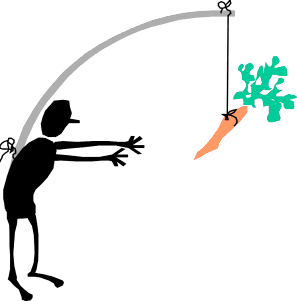
Motives create sequential action. Thinks of hamsters running on their little wheels to get food pellets in science experiments. The hamster aren't running for the thrill (well, some do but they're stupid), they are running to scarf down those oh so yummy pellets.

However, this DOES NOT mean you need loads of stuff happening to make the reader involved in your story.

Motives can be physical or psychological. 

Zoran Bekric has great information on motivation and how it relates to a story, which can be found here. But, I thought I'd quote him on here anyway. 

He says,

In the classic formulation, 'drama is conflict.' This is often misinterpreted to mean that, in order to be dramatic, a story has to have combat in it. This is untrue--as sheer number of highly effective stories that exist without a single punch being thrown should demonstrate. This is not to say that combat is unexciting--a good fight can be very eye-catching and stimulating--but without any sort of context, it's ultimately meaningless.


And, that's what motivation is. Context. Meanings behind your MC's actions. Why does he/she do the things they do?  You have to make the reader care about what's at stake. Who wins and who loses. Remember that the most intriguing clashes of motivation in a story are not only between the dueling motivations of two characters, but of the conflicting internal motivations as well.

I'm interested in hearing your thoughts.

Writers: What motivates your main characters? Is he/she someone you can relate to? Feel sorry for? How did you come to defining your character through their struggles?

Readers: What books have you read recently where you were engrossed in the main character's life? What books made you stop reading halfway through because you couldn't stand/relate to the MC? Why did you feel one way or another?

Nov 18, 2009

How NOT to Write a Novel

Read this. I bet you'll find it as amusing as I did.

Nov 16, 2009

Structure?

I'm going to talk about the importance of story structure today. Everyone knows that all stories should have a beginning, middle, and end (i hope). And, I believe all forms of story need some sort of structure whether it be drawn, written, or pictured in your mind.

What is structure? There are so many types of structure geared toward specific genres, but the most commonly used is the three act structure, which dates back centuries. Another is the five act structure, and those of you who watch desperate housewives can see it in the show.


***I'm a Gabby & Carlos fan. There's something about his personality on the show that I find absolutely adorable.***

I'm going to talk about how I approach story structure. Keep in mind that writers work in different ways. I know writers who set out with no written planning and only an idea in their head of the general concept/plot. I also know writers who plan out each scene from the dialogue to character movements.

I would have to say my style is somewhere in between. I outline my novel chapter by chapter, but only with a sentence or two for each one. And, usually, the chapter doesn't correspond with my first outline because I found another path. But, I don't just go with the new path. I re-do my outline and make sure the story has a fast-paced feel. (I'm not one for MC's who go about daily routines. I know how to brush my teeth, so I don't need two sentences on how the MC's gums are being treated.)

Some people storyboard it. You know, the story structure diagram you learn in, like, seventh grade and you attach post-its along the way. I can see how it works for people, its a great way to truly visualize how your story's going. My characters never shut-up in my head so its pretty easy visualize what they are doing along the way and during the dialogue. THey love showing it to me.

The best advice I have for writers is to be open to change. Planning too much detail beforehand can confine yourself to that story line and you may never see a better one that's dying for your attention.

Also, if you have trouble understanding structure and outlining, I suggest sitting in front of a t.v. and writing outlines of some of your favorite movies. You'll begin to noticing how journeys start of and how (if it's a good show or movie) there's a point to every spoken word and the low points the characters always face before the big boom.

I'm interested in hearing from you guys. Do you outline? Do you write blind? Is there a mix to your writing? Structure relates to the age old argument of whether writing is an art or a teachable craft. Do you think structure helps create solid blockbusters?

Nov 13, 2009

Sick of...

Here's a list of some characters I'm sick of seeing in novels:

1. B&B cheerleaders (blond & bitchy)--Not all cheerleaders are like this!

2. Native Americans who know all the old stories and traditions of their tribe to further a plot. Okay, I have a bestfriend who's NA and she knows nothing about her heritage. At least make 'em research their heritage to make it slightly different.

3. The evil clergy man. Yeah, enough said on that one.

4. The buffy replicates. Newsflash: You can't beat Buffy. Never. Stop trying.

5. The female protagonist complaining about the male-dominated world and using sexuality as a way to always get what she wants.

6. Angsty teens with no good reason to be. Can we get a sense of humor?

7. The hot jock who's suddenly attracted to plain jane.

8. This is a given, but I despise Mary/Gary Sues.

9. MC's that are written as bitches to prove their "tough."

10. Comic relief sidekicks that always have  a comment. It can get annoying sometimes and feel like theirs a laugh track in the novel.

11. Cops that the MC claims are oblivious to everything. Give them credit sometimes! I've never read a YA book where the cops were helpful.

Also, I think we should have more African American characters in novels. My MC's best friend, Lara, is and she's a non-bitchy cheerleader, too. See, you don't need stereo-types!

Oct 30, 2009

Angsty anyone?

As a rebellious teenager, I experienced my share of angst. We all do a lot of stupid, sometimes dangerous things when we're young. And, oh yes, I'm still young. So, after watching Vampire Diaries last night (yes, yes i gave in to the madness), I thought I'd do a post on angst and novels.

The ULTIMATE ANGSTY COUPLE has to be from my favorite show Greek. So, naturally, I will use them as an example and can only hope you'll somewhat follow along. The season finale is next week and a mourning period is in order. 


I'm TEAM CAPPIE all the wayyy. No, no Evan Chambers doesn't do it for me. Not at all. Cappie has my heart. . .Maybe it's because he shares some of my boyfriend's traits. Who knows.  Talk about angst though. I've been watching this show forever and waiting for the two of them to finally be together. Sure enough, it happens this week, and I'm in soo much tooth pain to really enjoy it. Luckily, I record it so I will watch the episode again. . .And every other one for that matter.

Okay, back to angst and books.

In my novels, I try to incorporate a lot of realism in my books. My teens are flawed--and even a bit badass. They have real problems and make serious mistakes (like, say, imagining having sex with her teacher). I don't know know any other way to build characters without having them come out like some mary sue. 

For me, angst is good. . .and a little dark. Think: dark chocolate. It's sweet on your tongue, then there's a brief bitter moment where you're thinking about milk chocolate and wondering if it's betrayed you. . .And, then the richy goodness seeps into your taste buds and you find yourself savoring every minute of it. In books, I go back to the best dialogue parts between the two who are getting hot and heavy. (not too hot thought because it is YA) On tv, well, I hit rewind. 

There has to be good build-up or else the final moment when they finally get together is rather. . .bland. Bland, bland, bland.  I'm all for edgy angst. The kind that breaks rules and has you cringing for the MC because you know what she's doing is so WRONG, yet you can't look away.

Hmmm. . .I guess that's why mine has an oh so wrong student teacher affair, huh? 

The thing about angst is. . .you never get your relief right away. No, it builds and builds and has you savoring those little moments here and there where you get some sort of dialogue/ action that makes you smile and hold out for another hundred or so pages. Your tension is like an elastic band, building and building until it eventually snaps. Only, hold out on the snapping for as long as possible before you have your readers screaming, "C'mon already!"

So, what do you think about teenage angst? Can you still relate to the angsty novels being written these days? Are your characters angsty wangsty? Do you have your favorite angsty couple? (yes, tv show can count!)

Oct 26, 2009

Tackling Tone

Narrative Tone:
A style mistake that can seriously undermine your story.

Most well-written stories have consistent narrative tone. The world of the story is predominantly frothy, ironic, comic, tragic, horrific. And, whatever the ups and downs of the plot, the narrator will have a distinct way to tell them

Why am I stating the obvious?

According to professional ghost writer Roz Morris, the most common problem agents/editors come across in novice manuscripts is an inconsistent and uneven narrative tone. When that happens, the experience of the story is off balance. 

Readers NEED to connect with the narrative tone and the kinds of things the narrator says. Once the trust between reader/author is built, you have to remain consistent. Any sudden change in tone could put your reader off if its not welcome and doesn't make any sense whatsoever. 

There are three main reasons why novice writers do this:
1. To provide comic relief or moments of humour
2. To show contrasting world views
3. To make sure the reader has the correct opinion of the character

So, what should you do in each of these cases?

1. Comic Relief- Some writers design characters whose main contribution is to add humor, which is not a bad thing. But they then feel they have to signal that these characters will be the clowns of the novel. So they switch to a slapstick narrative tone, and the depth of characterization goes out the window.

Here's the thing. . .There's no need to switch! 


Let's take Buffy the Vampire Slayer, which had comedy throughout without abandoning its mainly tragic mood. Imagine if Buffy had a laugh track every time something amusing happened and what it would do to the story.

Luckily, there's a way to spot and fix this. Reread your comedy moments and ask yourself if you've added a laugh track. If it doesn't fit with the rest of the novel, rewrite it. Remember: If you're putting comic moments into a story, don't put on a different narrative voice for it.  If your emphasis is on character depth, get your comedy from this - put the characters in a situation that will bring out amusing reactions and behavior. The reader will get it, honestly.

2. World Views- Another reason writers break their narrative tone is to contrast different worlds or world-views. (Wow, spelling world make me look at the word funny. Seriously, isn't it a weird spelling?) For instance, a high-schooler's lonely home life is contrasted with the joy and frolics at the local college's fraternity party, waking her up to all the cute boys she's been missing. Clever idea, but what people often see is the boring home life scenes narrated with sensitivity and insight, and the frat party as though it was bitchy chick-lit because it's meant to be wild and frothy.

Ahhhh, no.

The effect isn't fun, its jarring. People who read sensitive, insightful novels may not be the same people who'd enjoy bitchy-ness. Vice versa. Like before, your narrator needs to stay 'in character' while conveying the contrast.

3. Correct Opinion of Character- You might decide to write a novel where you tell us what to think of each and every character. Or your novel might present the characters and let us make up our own minds. . .Got it?

The problem here is when the author will let us make up our own mind about a bunch of characters, but with others they tell us what to think. The change from subtlety to spoonfeeding is like being booted into a different book. Downright irritating. Readers who enjoy subtle characterization are usually different from readers who want to be told.

You can fix this by narrating all the characters, not matter how despicable, with the same degree of perception and depth.

Oct 22, 2009

A Thought on MC

Problems can creep up on you like a shadow. And, very slowly, they grow over time like a plot. This thought just came to me, so bear with me if I don't make sense. Anyway, everyone needs a shadow. They need to learn from their shadows to help them develop.

So, here's a personal rule I thought up when writing your conflict: 

Every MC should have a shadow. And, the only way to get rid of the shadow is to turn off the lights, to stop running from the darkness and face what they fear. Head on. If your MC doesn't accomplish this in the end, then you, my friend, don't have a plot. You don't have a resolution, and you wind up leaving everything in the air.

You end up with unanswered questions, and readers who are scratching their heads.

Oct 16, 2009

Writer's Block

Here is an interesting post on it that you should check out.

How can you NOT agree with her? Luckily, I've never been on "hibernation." I've had just the opposite sometimes and that's TOO MANY ideas floating around in my head. It's hard to shove those babies out.

Also, seeing a reference to Joan made me smile because I haven't thought about the show in so long.